
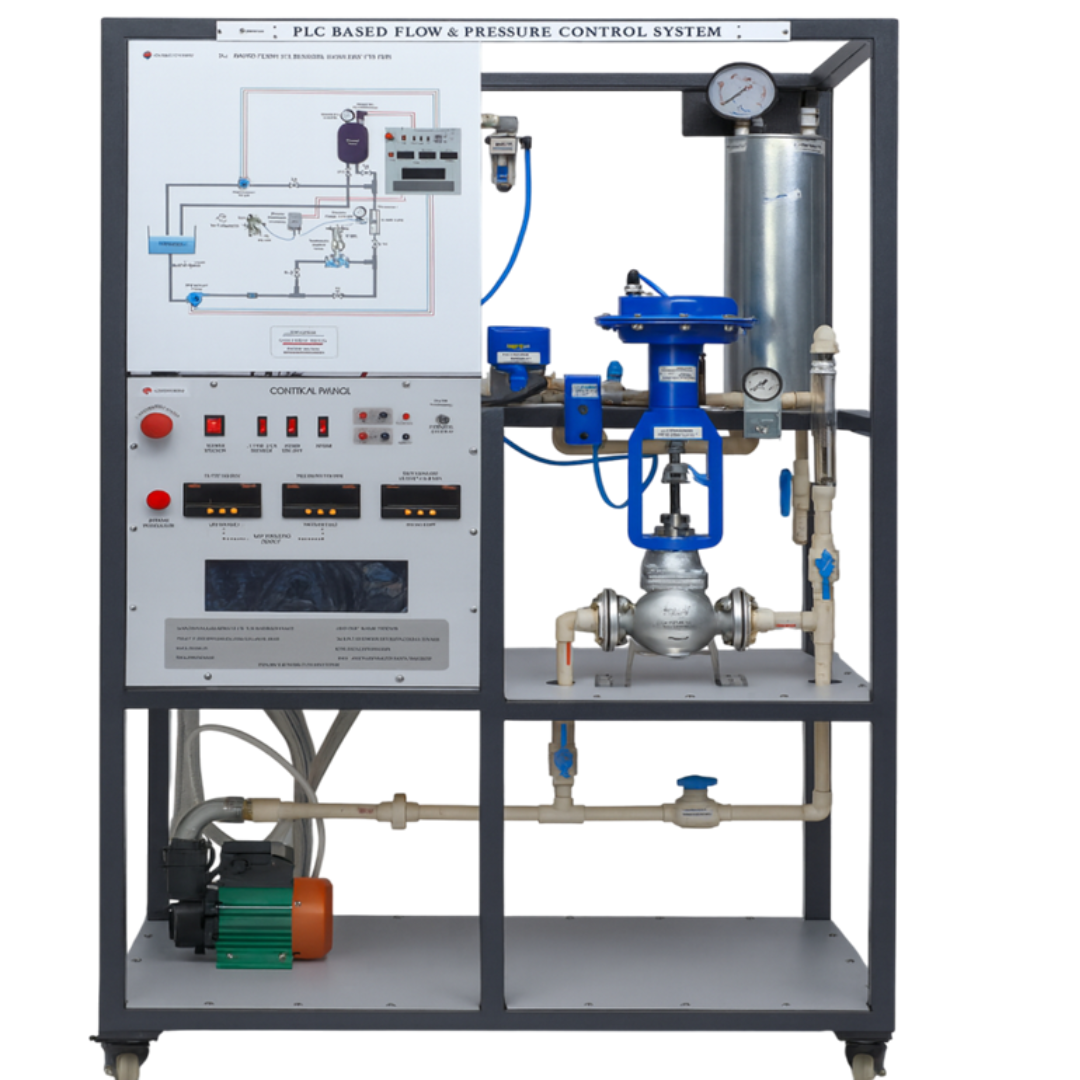
Description
IES-PCI-405
Technical Specifications
Air Pressure Measurement System – Industrial air pressure transmitter with measurement range 0–2.5 bar, providing 4–20 mA output signal and operating on 24 V DC supply (~50 mA) for accurate pressure monitoring.
Electro-Pneumatic Converter (E/P) – Signal conversion unit that converts 4–20 mA electrical signal into pneumatic output of 3–15 psi, enabling control of pneumatic actuators.
Pneumatic Control Valve – ½″ industrial globe-type control valve with equal percentage flow characteristic, designed for precise pneumatic flow and pressure control.
Pressure Vessel – Cylindrical pressure vessel with 150 mm diameter and 300 mm length, designed to withstand pressures up to 15 kg/cm² for pressure control experiments.
Process Piping Network – Industrial ¾″ CPVC / ½″ stainless steel piping system equipped with ball valves and leak-proof fittings to simulate real process piping.
Air Preparation Units (FRL) – Filter–Regulator–Lubricator units with pressure gauge, operating range 0–10 kg/cm², and ¼″ NPT/BSP connections to ensure clean and regulated compressed air supply.
PID Pressure Controller – Digital PID controller with universal / 4–20 mA input, 4–20 mA output, and full display for Process Value (PV) and Set Point (SP) for closed-loop pressure control.
Air Supply System – Air compressor with 50 L tank capacity, discharge approximately 2 CFM, powered by 1–2 HP motor, operating on 230 V AC supply with working pressure 5–6 kg/cm².
Electrical Control Panel – MS powder-coated control panel fitted with switches, indicators, test points, and front-mounted PID controller, with properly ferruled wiring and organized cable tray routing.
Mechanical Structure – Floor-mounted rigid MS industrial frame with four heavy-duty caster wheels with locking and brake mechanism for stability and mobility.
KEY FEATURES
Demonstration of single-loop P, PI, PD and PID pressure control
Step response & transient behavior analysis
Manual & Auto tuning of PID controller
Industrial-grade pneumatic components
External PLC/DCS integration capability
Safe, mobile design with MS powder-coated frame and caster wheels
Emphasis on industrial safety practices for pressurized systems
RANGE OF EXPERIMENTS
Closed-loop pressure control study
P vs. PI vs. PD vs. PID control comparison
Manual vs. auto tuning of PID
Step response and transient analysis
Pneumatic control valve behavior
Integration and operation with PLC/DCS (via I/O)
GENERAL
Application: Pressure Control Training for Process Control & Automation
Mounting: Floor-mounted mobile trainer
Safety: Regulated air supply, pressure-rated vessel, proper earthing, and electrical protection
Reviews
There are no reviews yet.